
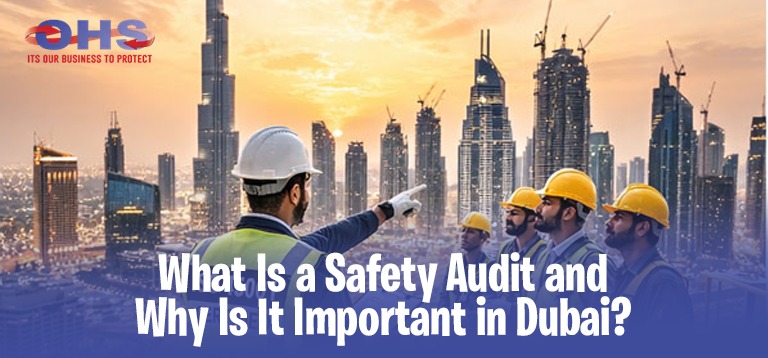
Dubai is now recognized as one of the world’s fastest-growing corporate centers, thanks to tremendous economic expansion. With increasing building projects, industrial facilities, corporate offices and hospitality industries, worker safety has become a primary focus for enterprises operating across the UAE.
In this climate, safety audits are not optional; they are a business requirement. CorporateOHS supports enterprises across Dubai and the entire UAE in carrying out complete, compliant and proactive safety audits that safeguard their personnel and reinforce their operations.
What Is a Safety Audit?
A safety audit is a structured, detailed review of an organisation’s workplace health and safety management system (WHS). It examines policies, procedures, practices, physical conditions and staff conduct to ensure that legal standards and industry best practices are being met. A safety audit has a greater scope than a standard safety inspection, which concentrates on finding immediate physical concerns. It reviews a business’s whole workplace health and safety (OHS) system, discovering loopholes, inefficiencies and non-compliance issues before they cause accidents or regulatory fines.
There are three primary types of safety audits:
- Compliance Audit: Verifies adherence to UAE laws and regulatory requirements.
- System Audit: Reviews the overall safety management system for effectiveness and structure.
- Process Audit: Examines specific operational processes to identify safety risks in day-to-day activities.
Legal Framework for Safety Audits in Dubai and the UAE
The UAE has a strong legal framework for safety at the workplace. The fundamental law is the UAE Federal Law No. 8 of 1980 (Labour Law), which defines the employer’s duties regarding the health, safety and welfare of employees. Companies in Dubai are also subject to rules issued by the Dubai Municipality that create occupational health and safety standards for specific industries. The OSHAD Sustainability Framework (OSHAD-SF) is the overarching regulatory framework for enterprises operating in Abu Dhabi or across multiple emirates.
The Ministry of Human Resources and Emiratisation (MOHRE) also has an important role in making sure that private sector businesses conform to workplace safety regulations. Not conforming to these requirements can lead to hefty fines, work stoppages and reputational damage. Regular safety audits guarantee that organizations are 100% compliant with these changing regulatory standards and display a proactive approach to employee satisfaction.
Key Components of a Safety Audit
A comprehensive workplace safety audit conducted by CorporateOHS typically covers the following areas:
- Hazard Identification and Risk Assessment: Identifying physical, chemical, ergonomic, and environmental hazards present in the workplace.
- Review of Safety Policies and Procedures: Assessing whether documented health and safety policies align with UAE legal requirements and international OHS standards.
- Equipment and Machinery Inspection: Evaluating the condition, maintenance records, and safe operation of tools, machinery, and equipment.
- Employee Training and Competency Records: Reviewing records to confirm workers have received appropriate safety training, toolbox talks, and certifications.
- Emergency Preparedness and Response Plans: Verifying that fire safety procedures, evacuation plans, first aid provisions, and incident reporting systems are in place and functional.
Why Safety Audits Are Important for Dubai Businesses
- Ensuring Regulatory Compliance
The regulatory climate in Dubai is getting more and more strict. Regular inspections are conducted by authorities, including Dubai Municipality and MOHRE, and non-compliant enterprises might risk penalties, project shutdowns or legal action. A proactive safety audit will enable your firm to identify and fix compliance holes even before the government arrives.
- Protecting Employee Health and Safety
Occupational health and safety is really about safeguarding people. A safety audit helps firms find uncontrolled risks that can result in workplace injuries, illnesses or deaths. Industries including construction, manufacturing, oil and gas and hospitality all important sectors in Dubai – require strong safety measures to protect every person on site.
- Reducing Financial and Legal Liabilities
Workplace accidents can be highly costly – not just in human terms, but monetarily too. Medical bills, compensation claims, legal costs, project delays and reputational harm can all have a significant impact on a business’s bottom line. Regular safety audits will lower the likelihood of occurrences and thereby reduce these liabilities.
- Enhancing Business Reputation and Client Trust
In Dubai’s high-pressure business environment, a good safety record is highly valued by clients, investors and business partners. Many of our large clients and government contracts now require contractors and suppliers to demonstrate a credible safety management system. Regular audits provide recorded proof that you care about workplace safety – giving your organization a measurable competitive edge.
- Lowering Insurance Costs
Organizations that can demonstrate a consistent, well-documented approach to safety risk management are often rewarded with lower insurance premiums. Insurance providers recognize that businesses with fewer incidents and proactive safety controls represent a lower risk, resulting in meaningful cost savings over time.
Who Should Conduct a Safety Audit?
Safety audits can be carried out either internally by a competent in-house safety officer or externally by a registered OHS consultancy. Internal audits are great for ongoing monitoring, but external safety audits provide an objective, expert-level review of your organization’s risk profile. External auditors have a professional understanding of UAE rules, industry standards and global frameworks such as ISO 45001.
At CorporateOHS, we have a team of qualified safety auditors and OHS consultants with years of experience in a wide range of sectors, including construction, facilities management, manufacturing and corporate environments. Our detailed, practical audit reports give business owners and safety officials an easy-to-follow roadmap to change.
How Often Should a Safety Audit Be Conducted?
How often you do safety audits will depend on the type of business you operate and the level of risk involved. As a rule of thumb, most companies in Dubai should do a complete safety assessment at least once a year. But high-risk industries such as construction, oil and gas and heavy manufacturing may need to have audits every six months or following a major workplace incident. Audits should also be triggered by major operational changes, new regulatory updates or after the introduction of new equipment or procedures.
Conclusion
One of the most effective tools available to business owners and safety professionals in Dubai is a Safety Audit. It offers you an impartial, comprehensive view of your organization’s occupational health and safety performance – helping you stay legally compliant, safeguard your staff, reduce financial risk, and establish a culture of safety that improves your business from within.
CorporateOHS is a Dubai-based company providing professional safety audit services in the context of the regulatory environment of Dubai and the UAE. If you’re a safety officer trying to benchmark your present systems, or a business owner wishing to ensure full legal compliance, our expert team is here to support you.
Get in touch with CorporateOHS immediately to arrange your workplace safety audit in Dubai and begin the journey towards a safer, more compliant and resilient firm.